

What Is Rebar and Why Is It Essential for Concrete Reinforcement?
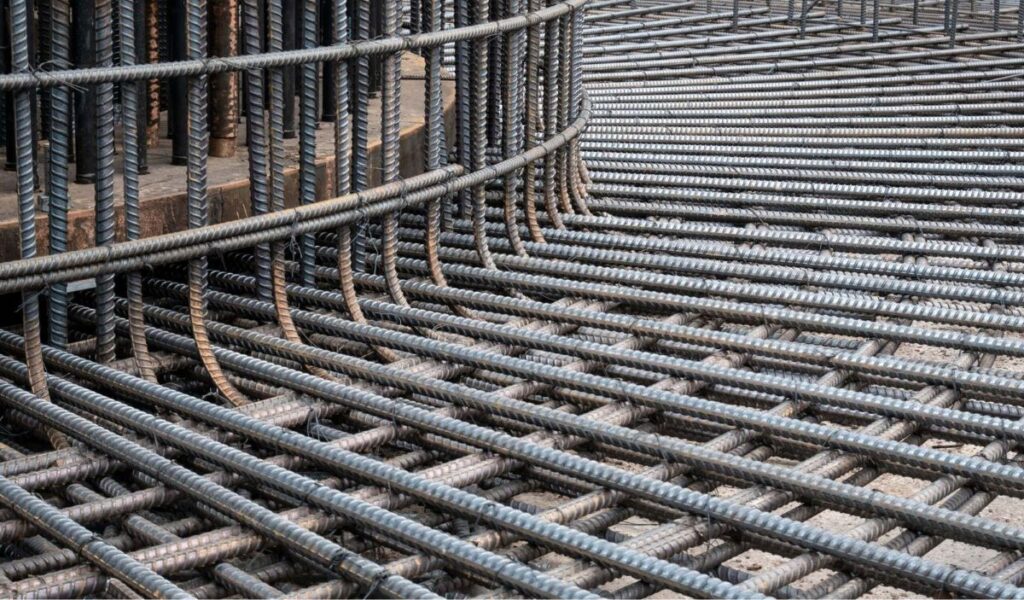
Rebar, short for reinforcing bar, is a patterned steel rod embedded within concrete structures to compensate for concrete’s inherent weakness in tension. These steel bars feature ridges or deformations along their surface, creating a mechanical bond with the surrounding concrete that prevents slippage under load.
Concrete excels at resisting compression but fails dramatically when subjected to tensile (pulling) forces. Rebar addresses this critical limitation by absorbing tensile stresses that would otherwise cause concrete to crack and fail. When loads bend or stretch a concrete element, the embedded steel reinforcement carries these tensile forces while the concrete handles compression.
The reinforcement provides three key structural benefits:
- Enhanced tensile strength – Steel’s tensile capacity is roughly 100 times greater than concrete, transforming a brittle material into a ductile composite
- Crack control – The steel mesh distributes loads across the structure, preventing localized stress concentrations that initiate cracks
- Structural integrity – Even if cracks form, rebar holds the concrete together and maintains load-bearing capacity
Rebar reinforcement appears in virtually every concrete application requiring durability and strength. Residential driveways rely on rebar grids to prevent cracking from vehicle loads and temperature changes. Building foundations use dense rebar cages to support structural loads and resist soil pressure. Concrete slabs in garages, basements, and commercial floors incorporate rebar spacing calculated for their specific load requirements.
The steel composition typically contains recycled materials, making rebar both cost-effective and environmentally sustainable. Standard rebar consists of carbon steel, though specialized applications may use epoxy-coated or stainless steel variants for corrosion resistance. Understanding how many rebars you need for concrete reinforcement requires calculating the proper grid spacing and quantity to match your project’s structural demands—a process simplified through practical calculator tools designed for this purpose.
How to Find the Right Measurements for Rebar Calculation
Getting the right slab dimensions is crucial for calculating how much rebar you need. You must know the exact length and width of your concrete slab before figuring out how many reinforcing bars to buy.
Step 1: Measure the Slab Dimensions
- Use a measuring tape to measure the longest side of your planned concrete pour. This will be your length measurement.
- Measure the side that is perpendicular to the length. This will be your width measurement.
- If your slab is rectangular, double-check your measurements by ensuring that the opposite sides are equal.
- Write down these measurements in either feet or meters, making sure to use the same unit system throughout.
Step 2: Understand Edge Spacing
Edge spacing is the distance from the outer edge of the slab to the first line of rebar. Depending on your project requirements, this measurement usually falls between 2 to 4 inches (50 to 100 mm). Edge spacing is important because it keeps the rebar away from the surface, preventing corrosion or damage to the concrete’s strength.
Step 3: Calculate Grid Dimensions
To find out how much space you have for placing rebar, you’ll need to do some calculations:
- Grid length = Slab length – (2 × Edge spacing)
- Grid width = Slab width – (2 × Edge spacing)
These calculations give you the actual area where rebar will be installed. For instance, if you have a 10-foot slab with 3-inch edge spacing, your grid dimension would be 9.5 feet (10 feet – 0.5 feet).
What Role Does Rebar Spacing Play in Calculating Quantity?
Rebar spacing refers to the distance between parallel reinforcing bars within the concrete grid. This measurement directly determines how many bars you’ll need and how effectively your concrete resists cracking under load.
The spacing creates a mesh pattern that distributes stress throughout the structure. Closer spacing means more bars and stronger reinforcement, while wider spacing reduces material costs but may compromise structural integrity. Each bar in the grid works to prevent cracks from spreading, so the distance between them affects the concrete’s ability to handle tension forces.
Common Spacing Standards
Standard rebar spacing typically ranges between these intervals:
- 12 inches (30 cm): Light-duty applications like residential driveways and thin slabs
- 18 inches (45 cm): Medium-duty projects including garage floors and standard patios
- 24 inches (60 cm): Minimal reinforcement for non-structural applications
Heavy-duty commercial projects or areas with significant load requirements may use spacing as tight as 6-8 inches.
Selecting the Right Spacing
Your project’s load-bearing requirements dictate appropriate spacing. Consider the slab thickness, expected weight loads, soil conditions, and local building codes. Thicker slabs supporting heavy equipment need tighter spacing than thin decorative patios. Consulting structural specifications or engineering guidelines ensures your spacing meets safety standards while avoiding unnecessary material waste.
How Can You Calculate the Number of Rebars Needed Using Slab Dimensions and Spacing?
The calculation starts by determining your grid length and grid width, which represent the actual area where rebar will be placed. Subtract twice the edge spacing from both your slab length and slab width. For example, if your concrete slab measures 20 feet by 15 feet with 3 inches of edge spacing, your grid length becomes 19.5 feet (20 – 0.5) and grid width becomes 14.5 feet (15 – 0.5).
Once you have these grid dimensions, divide each by your chosen rebar spacing to find how many bars you need in each direction. Using 12-inch spacing as an example:
- Vertical bars = Grid length ÷ Spacing = 19.5 feet ÷ 1 foot = 19.5, rounded to 20 bars
- Horizontal bars = Grid width ÷ Spacing = 14.5 feet ÷ 1 foot = 14.5, rounded to 15 bars
Always round up to the nearest whole number since you cannot install partial rebar pieces. This mathematical approach ensures complete coverage across your concrete slab, creating a uniform reinforcement grid that distributes stress evenly throughout the structure. The precision of these calculations directly impacts material ordering and project costs, making accuracy essential for efficient concrete reinforcement planning.
How Do You Compute Total Rebar Length and Number of Pieces Required?
Total rebar length combines the measurements from both directions of your reinforcement grid using a straightforward formula. Multiply the number of vertical bars by the grid width, then add the result of horizontal bars multiplied by grid length.
The formula looks like this:
Total Length = (Number of Vertical Bars × Grid Width) + (Number of Horizontal Bars × Grid Length)
For example, if you have 8 vertical bars spanning a grid width of 10 feet and 6 horizontal bars spanning a grid length of 12 feet:
- Vertical contribution: 8 × 10 = 80 feet
- Horizontal contribution: 6 × 12 = 72 feet
- Total rebar length: 80 + 72 = 152 feet
Once you know the total length needed, divide this number by the standard length of individual rebar pieces available at your supplier. Standard rebar typically comes in 20-foot or 6-meter lengths, though other sizes exist.
Using the example above with 20-foot pieces:
152 feet ÷ 20 feet = 7.6 pieces
Always round up to the nearest whole number, meaning you’d need 8 rebar pieces to complete your project. This rounding ensures you have sufficient material, accounting for cutting waste and measurement variations during installation.
How Does Rebar Size Affect Your Calculation and Project Cost?
Rebar size directly influences both the structural capacity of your concrete and the total project budget. The diameter you select determines how much load the reinforcement can handle and how many pieces you’ll need to purchase.
Common Rebar Sizes
Rebar comes in standardized dimensions across two measurement systems:
Imperial Sizes (U.S.)
- #3 (3/8 inch diameter)
- #4 (1/2 inch diameter)
- #5 (5/8 inch diameter)
- #6 (3/4 inch diameter)
Metric Sizes
- 10mm
- 12mm
- 16mm
- 20mm
Impact on Strength and Quantity
Larger diameter bars provide greater tensile strength but cost more per linear foot. A #6 rebar offers significantly more reinforcement than a #3, meaning you might use fewer bars with wider spacing for the same structural integrity. This trade-off affects your calculation: choosing thicker bars reduces the total number of pieces needed but increases the cost per unit.
Residential slabs typically use #3 or #4 rebar, while commercial projects or heavy-load applications require #5 or #6. The diameter choice depends on expected loads, local building codes, and engineering specifications. Thicker bars also add more weight to transport and handle on-site, influencing labor costs beyond just material expenses.
What Are the Benefits of Using a Practical Calculator Tool for Rebar Estimation?
A practical calculator tool eliminates manual computation errors and saves significant time when determining how many rebars you need for concrete reinforcement. These digital tools handle multi-step formulas instantly, reducing the risk of miscalculations that could compromise structural integrity or lead to material waste.
Time-Saving Accuracy
Manual calculations require working through multiple formulas—subtracting edge spacing, dividing grid dimensions, and converting measurements. A calculator automates these processes, delivering accurate results in seconds rather than minutes.
Essential Inputs for Most Rebar Calculators
Essential inputs for most rebar calculators include:
- Slab dimensions: Length and width measurements in feet or meters
- Edge spacing: Distance from slab perimeter to first rebar line
- Rebar spacing: Center-to-center distance between parallel bars
- Individual bar length: Standard piece length (typically 20 feet or 6 meters)
- Unit price: Cost per rebar piece for budget estimation
The calculator processes these parameters through established formulas, generating outputs for total rebar length needed, number of pieces required, and projected material costs. This comprehensive approach helps contractors and DIY builders make informed purchasing decisions without spreadsheet complexity.
Additional Features of Professional-Grade Calculators
Professional-grade calculators often include additional features like weight calculations, different rebar size options, and the ability to save multiple project estimates for comparison. For instance, understanding the specific requirements outlined in detailed documents can significantly enhance the accuracy of your estimates. Moreover, in regions prone to seismic activities, such as those specified in California’s Seismic Design Criteria, utilizing a practical calculator tool becomes even more essential to ensure all safety standards are met during the rebar estimation process.
Why Should Welding Be Avoided When Working With Rebars?
Welding creates significant welding risks that compromise the structural integrity of reinforcing steel. The intense heat from welding operations alters the molecular structure of rebar, introducing thermal stress that weakens the steel at and around the weld point. This heat-affected zone becomes brittle and loses the flexibility that makes rebar effective at absorbing tensile forces in concrete.
The thermal stress from welding can reduce the steel’s load-bearing capacity by up to 20-30%, creating potential failure points in your concrete structure. The high temperatures also burn away the protective mill scale on rebar surfaces, accelerating corrosion once embedded in concrete. Rapid cooling after welding can cause micro-cracks that propagate over time under structural loads. Check out more about corrosion protection system.
In contrast, steel wire ties provide a safer, more reliable method for securing rebar intersections. These ties:
- Maintain the original strength properties of the reinforcing steel
- Allow for slight adjustments during concrete placement
- Cost significantly less than welding equipment and labor
- Require minimal training to apply correctly
- Create flexible connections that accommodate concrete settling
Wire tying, which is a method similar to pattern welding, uses 16-18 gauge annealed steel wire twisted around rebar intersections with pliers or automatic tie guns. This method keeps bars positioned correctly within the formwork while preserving their engineered strength characteristics throughout the concrete’s curing process and service life.

Conclusion
Proper reinforcement design transforms ordinary concrete into structures that resist cracking, support heavy loads, and last decades longer than unreinforced alternatives. The difference between a driveway that crumbles within years and one that endures for generations often comes down to correct rebar placement and quantity.
How Many Rebars Do You Need for Concrete Reinforcement? A Practical Calculator Guide answers this question through systematic measurement and calculation. Calculator tools eliminate guesswork by processing your project dimensions, spacing preferences, and material specifications into accurate quantities. This precision prevents costly material waste and structural weaknesses.
Best practices matter: measure accurately, maintain consistent spacing, secure bars with wire ties, and verify calculations before pouring. Your concrete project deserves the strength that only proper rebar reinforcement provides.
Related : Temporary Scaffolding: What Does Australian Law Require for Safety and Stability?